Blog
Reconstitution Solutions in Peptide Research: Selection and Documentation
Published Aug 20, 2026 · Amide Club Editorial
Selecting a reconstitution solution is a method-development question. The correct choice depends on peptide properties, the analytical workflow, target concentration, compatibility requirements, and the controls defined by the laboratory. A universal recipe copied from a product page is not a substitute for a validated protocol.
Define the purpose first
A solution prepared for chromatographic analysis may have different requirements from one used in a cell-free assay or another controlled research workflow. Researchers should define the required pH, ionic strength, compatibility with downstream instrumentation, expected holding time, and acceptable background before selecting a solvent or buffer.
Document the full preparation context
- Material name, lot, and stated quantity
- Solution identity, lot, grade, and expiry where applicable
- Volumes, calculated concentration, and units
- Order of addition and mixing method
- Temperature, timing, and visible observations
- Container and closure used
- Any analytical confirmation or deviation
Separate compatibility from microbiological quality
A solution can be chemically compatible without meeting a microbiological requirement, and microbiological labeling does not establish compatibility with a particular peptide or assay. Sterility and endotoxin controls are separate questions that require suitable methods when relevant to the research protocol.
Use small-scale method checks
When a method has not been established, a controlled small-scale evaluation can reduce waste and reveal precipitation, adsorption, or instrument incompatibility. Acceptance criteria should be decided in advance, and observations should be retained with the experiment record.
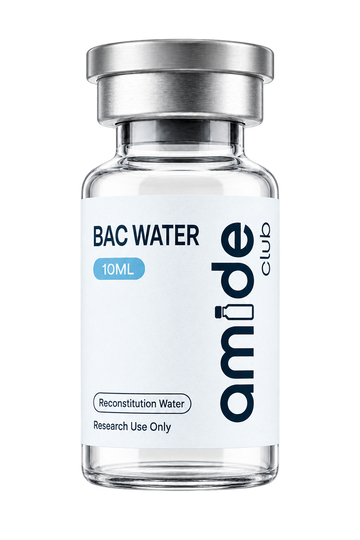
Amide Club provides complementary laboratory supplies and clear product-format information to support an organized research workflow. Its role is to supply documented materials; the laboratory remains responsible for method selection, validation, and controls.
This article does not provide instructions for injection, dosing, or administration. Amide Club products are strictly for controlled laboratory research.